The Seven Sisters and the Suitor
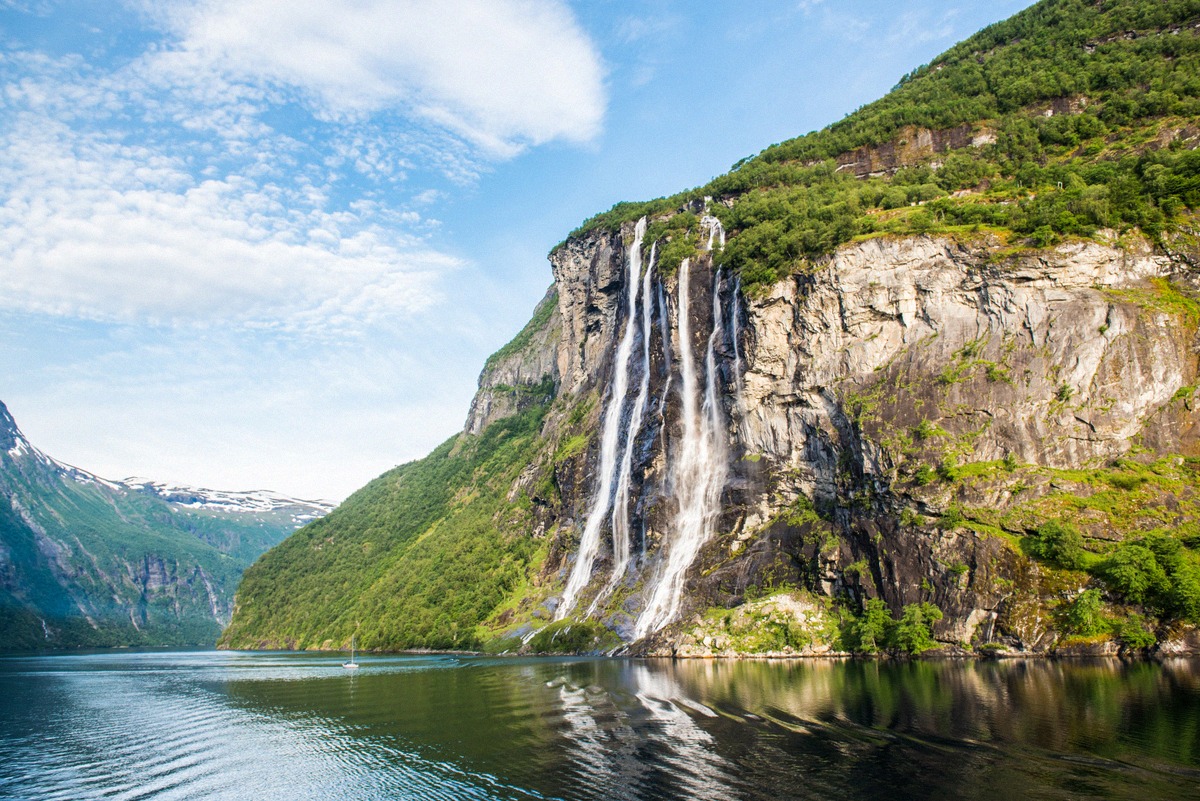
The Seven Sisters waterfall, in Norwegian Dei sju systrene, falls in seven separate streams almost vertically into the Geirangerfjord on the north side of the fjord by the Knivsflå farm. The free fall averages about 250 m. The Geirangerfjord has been a UNESCO World Heritage Site since 2005.
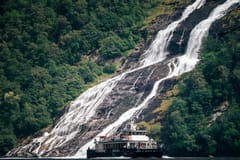
Opposite is the Suitor (Friaren), formerly known as Skageflåfossen. It splits in the middle and looks like a bottle. Its name comes from a legend: the Suitor courted the sisters on the other side of the fjord in vain. Also on the north side is the Bridal Veil (Brudesløret), which the boats pass on their way to the Seven Sisters.
How much water pours over the edge changes through the year. The Seven Sisters usually carry the most water from May to July. The weather forecast for the fjord is under Weather.
From the water
You get closest to the falls on the water. The fjord cruise from Geiranger takes 75 minutes, the quiet cruise 2 hours; a new catamaran is used for the longer trip. Both pass the Seven Sisters, the Suitor and the Bridal Veil.
On the 75-minute fjord cruise you can get off at Skagehola, walk up to the Skageflå farm and be picked up again later. There is a surcharge for getting off, which goes to the landowners.
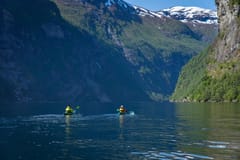
You can also paddle yourself: the four-hour guided kayak tour from Homlong goes to the Seven Sisters and the Suitor, from age 13. Boat trips, RIB and kayaking with duration, season and minimum age are compared on the Tours page.
From above
From Ørnesvingen (Eagle’s Bend) you see the Seven Sisters and the Knivsflå farm. The viewing platform is on Ørnevegen (Eagle Road), the road with eleven hairpin bends that climbs from Geiranger towards Eidsdal. More platforms above the fjord are described on the Viewpoints page, and the view from the mountain above the village on the Dalsnibba page.
From Skageflå you look across to the Seven Sisters on the other side of the fjord. The abandoned farm lies on the south side, about 250 m above the fjord.
Walking to Skageflå
In the summer season you take the boat to Skagehola on the fjord shore and climb from there to Skageflå in 30 to 45 minutes. The path is very steep; the steepest and most exposed sections are secured with steps and railings. Small children should not walk it on their own.
From Skageflå the path continues via Homlongsætra to Homlong. The summer farm lies at 544 m, and this section takes 2 to 3 hours. From Homlong it is about 2 km back to the village. The guided hike takes 5 to 6 hours, including the boat trip from Geiranger, the climb to Skageflå and the descent via Homlong.
More old farms cling to the steep slopes above the fjord. Knivsflå, next to the Seven Sisters, was abandoned in 1898. Blomberg lies about 450 m above the fjord. The fjord farms are private property: only enter buildings with the owners’ permission, and leave stones and walls as they are.
The Waterfall Walk in the village
Water tumbles over the rocks in the middle of Geiranger too. The Waterfall Walk, in Norwegian Fossevandring, leads from the village centre past Storfossen up to the Norwegian Fjord Centre: 327 steps and 85 m of ascent. What the Fjord Centre offers is covered under Things to do.
Fosseråsa runs from the village centre up to Storsæterfossen. Since 2019 it has been a nasjonal turiststi, one of Norway’s national hiking trails, and in 2024 this status was confirmed for another five years. From the Vesterås farm it takes 45 to 60 minutes each way to Storsæterfossen. The path passes behind the waterfall.