Ålesund–Geiranger: Leise Fjordfahrt, einfache Fahrt
One-way fjord cruise from Ålesund or Geiranger on our brand new hybrid electric boat to the UNESCO-listed Geirangerfjord, with stunning scenery, waterfalls, silent fjord cruising.
To Geiranger by car, ferry, bus and boat
Two roads lead to Geiranger: from the north via Eidsdal and Ørnevegen (Eagle Road), and from the south via Langvatnet. The southern road is closed in winter. There is also the car ferry from Hellesylt. Without a car you travel by bus and ferry or by boat from Ålesund, which also has the nearest airport.
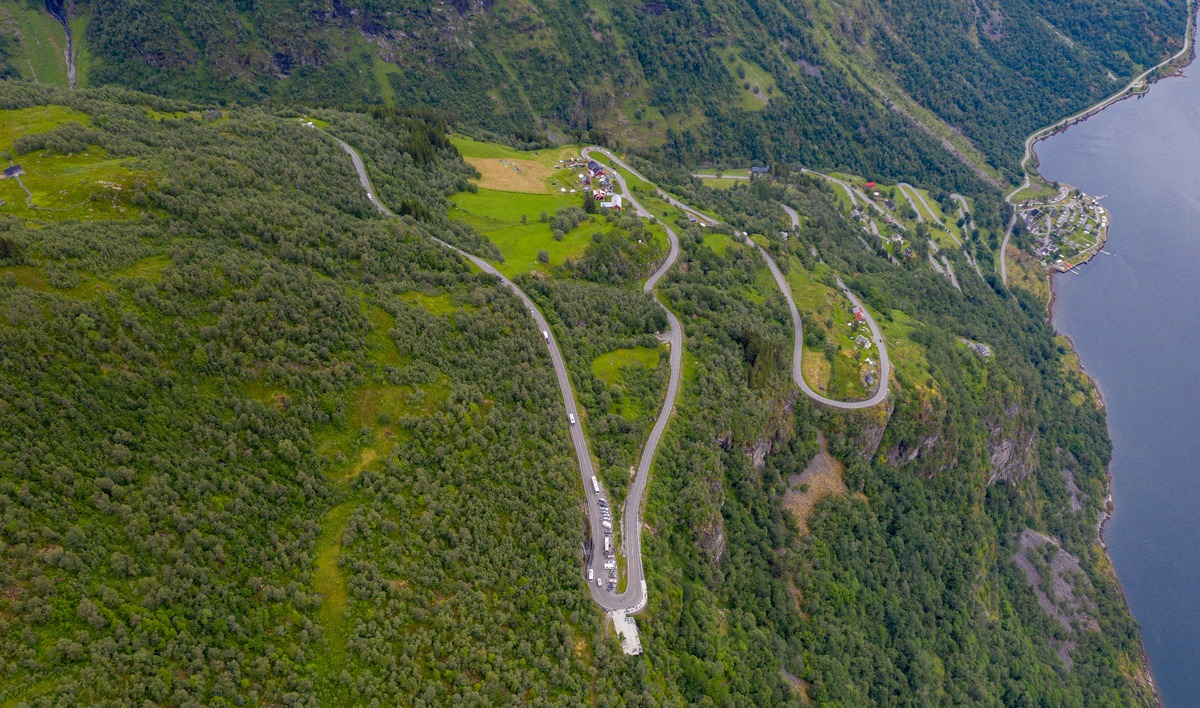
The Fv63 (county road 63) reaches Geiranger from two directions, from the north and from the south.
From the north: Coming from Valldal and Trollstigen, you take the ferry between Eidsdal and Linge and then drive down Ørnevegen (Eagle Road) into the village. This approach is open all year. The ferry takes about 13 minutes and runs daily; the timetable is published by FRAM, the public transport company of Møre og Romsdal county. The road is part of the National Tourist Route Geiranger-Trollstigen, which is about 104 km long including the ferry.
From the south: Here the Fv63 branches off the Rv15 at Langvatnet and descends to Geiranger. The section between Langvatnet and Geiranger is closed in winter, as is Trollstigen. The Rv15 over Strynefjellet, which this road joins, is often closed in winter or only passable in convoy.
Closures: Statens vegvesen, the Norwegian Public Roads Administration, reports whether a road is closed or only passable in convoy. Nasjonale turistveger (National Tourist Routes) lists which sections of the route to Trollstigen are closed in winter.
Tunnel plans: A new tunnel for the Rv15 at Strynefjellet with a branch to Geiranger would give the village a road that is open all year. The project is still at the planning stage and no date has been set for the start of construction.
A car ferry runs through the fjord between Hellesylt and Geiranger. The crossing takes about an hour.
The timetable and operating days change with the season. To see which departures run on your travel day, use the Entur journey planner, Norway’s national planner for buses, trains and boats, and search for the stop Hellesylt ferjekai. The ferry quays in Hellesylt and Geiranger are run by Stranda Hamnevesen, the port authority of Stranda municipality.
Without a car you can reach Hellesylt by bus from Ålesund, see By bus. Like all passenger ships on the fjord, the ferry is subject to the zero-emission rule.
From Eidsdal: Bus 211 runs from Eidsdal ferry quay via Ørnesvingen to Geiranger and in the village also stops at the Union Hotell. It runs Monday to Friday only, and some departures wait for the ferry from Linge.
From Ålesund: A FRAM bus runs from Ålesund via Sykkylven and Stranda to Hellesylt and on to Stryn, at weekends too. In Hellesylt you change to the ferry to Geiranger. Bus and ferry tickets are bought separately; you buy the bus ticket in the FRAM or Entur app or by card on the bus. Timetables for both lines are on the FRAM website.
From Oslo: In summer the Vy express bus VY450 runs daily from Oslo via Lom to Geiranger and on to Ålesund. Timetables and tickets are available from Vy.
The nearest airport is Ålesund Vigra. From there it takes two and a half to three hours to drive to Geiranger. Without a car, the airport bus takes about 25 minutes to central Ålesund. Airlines flying to Ålesund include SAS, Norwegian, Widerøe, KLM and Wizz Air. Avinor, the airport operator, shows how to continue your journey from the airport.
Boat from Ålesund: Boat trips from Ålesund to Geiranger are listed under Tours.
Hurtigruten: On the northbound route, Hurtigruten ships sail into the Geirangerfjord in summer. They do not dock there; a tender boat takes you ashore.
Havila: Havila Voyages sails northbound into the Geirangerfjord from 1 April to 31 August and stops in Geiranger for about 20 minutes.
The port of Geiranger is run by the municipal port authority Stranda Hamnevesen. It includes the 236 m SeaWalk pier, the 56 m Geiranger kai and the 90 m Geiranger Brygge floating pontoon, plus three anchorages in the fjord. If your ship lies at anchor, tender boats take you ashore.
The Geirangerfjord and the Sunnylvsfjord are among Norway’s World Heritage fjords, where a zero-emission rule applies to passenger ships. Since 1 January 2026, ships under 10,000 gross tonnage may not emit CO₂ or methane there; for larger ships the rule applies from 2032. This covers cruise ships as well as ferries and sightseeing boats. Temporary exemptions exist for individual ships and expire by the end of 2029 at the latest.
Parking: In the village you park in numbered car parks. You pay at the machine by card or coins, or by app. Most car spaces can be used around the clock, with charges from 08:00 to 20:00. The Parking in Geiranger map shows in which months charges apply and where the car parks are. Motorhomes have their own bays, which are closed at night. Where you can stay overnight in a motorhome is covered under Where to stay.
EV charging: At the Norwegian Fjord Centre (Norsk Fjordsenter), about 1 km from the village centre, there is a 50 kW rapid charger for CHAdeMO and CCS plus two 11 to 22 kW charging points. Both are accessible around the clock. The Fjord Centre’s other charging points can be used during opening hours; ask at reception.